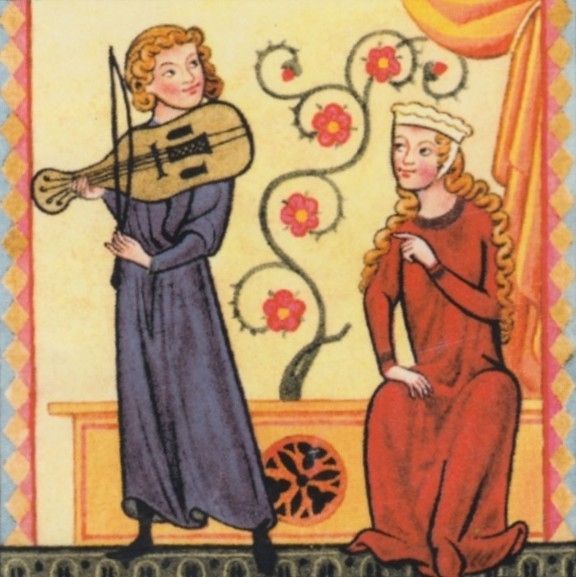
In troubadour poetry, the alba is a dawn song. Lovers separating before the world catches them. The night as the only safe space for what cannot exist in daylight. A watchman cries the hour, the birds begin, and someone has to leave before they're seen.
It's one of the most emotionally precise forms in Western literature. The entire weight of the poem rests on a single structural fact: the love is real and the morning is coming and those two things cannot coexist.
I didn't know any of this when I wrote Chapter 49 of Anamnesis.
In that chapter, Lyre lies in the pre-dawn dark memorising Caelan. The shape of him. The warmth. The bells haven't rung yet but they're coming. She knows she's about to walk out to meet the mountain, and something in her is already grieving the leaving before it happens.
It's an alba. Structurally, emotionally, beat for beat. Except the night belongs to the wrong man.
The alba-feeling — that ache of stolen time running out — belongs to Riven. The love that can't exist in daylight, the one the world won't allow, the one that requires darkness and secrecy and the particular tenderness of borrowed hours. That's Riven's register. Caelan is the daylight. He's warmth without urgency, safety without cost. He's not the love you have to hide.
But Lyre performs the alba with Caelan anyway. She gives him the form that belongs to someone else. And the displacement is doing something very precise: the shape promises one thing and delivers another. Which is exactly what Caelan himself does throughout the book.
The demon visits Lyre
In my first essay I wrote about Nietzsche's eternal return — the demon who steals into your loneliest loneliness and asks: would you live this life again, exactly as it was, for eternity?
I said then that Riven was the one living the question. And he is. Six hundred years of returning. But I've been thinking about it since, and I've realised something that changes the whole shape of the story.
Riven has already answered.
He may not know it. He interrogates it in the coda, sitting alone, watching Lyre sleep, asking himself whether what he feels is love or the habit of loving. But the evidence of his existence is the answer. Six hundred years of showing up. That's not ambivalence. That's a man who has, through sheer accumulation of action, said god. He keeps coming back. The body has decided even if the mind hasn't caught up.
Lyre is the one who gets the demon's visit in the form Nietzsche actually describes. She wakes into each life without the memory. No weight. No accumulated centuries of grief and devotion. She just lives. Falls into the same patterns. Finds the same people. Moves toward the same fire without knowing it's been lit before.
But in this cycle, something is different. The seal is cracking. Scythe is named. The memories are surfacing. For the first time she's being handed something close to the demon's actual proposition — not the thought experiment but the lived reality of it. This life as you now live it. The same succession and sequence.
And the question the trilogy is building toward is whether, fully knowing, she chooses it anyway.
The one who could have walked away
This reframes the entire love triangle.
Caelan isn't just the wrong choice or the betrayer or the villain-in-progress. He's the alternative to the demon's question. He's the life that wouldn't repeat. The new thing, the clean start, the love without the weight of centuries behind it. Choosing Riven means choosing the pattern. Choosing Caelan would have meant stepping out of it.
Which means the triangle isn't really a triangle at all. It's the demon's binary wearing a different costume.
Curse him or call him god. Choose the pattern or refuse it. Riven or Caelan.
But here's the thing I keep circling back to: the demon or the god only means something if refusing was real. If Caelan was never a genuine option — if he was always just the obstacle, always just the thing in the way of the destined love — then Lyre's choice is no choice at all. It's inevitability wearing the costume of agency.
The trilogy needs her to have genuinely wanted to step out of the cycle. Needs the reader to feel what it would have cost — the relief of it, the ordinariness of it, the love that doesn't come pre-loaded with six hundred years of grief. Otherwise, the final yes to Riven is just a genre convention and not a philosophical act.
Not Guinevere
There's a version of this story where Lyre is Guinevere or Iseult — the woman at the centre of the triangle who is desired by both men and must choose between them. Acted upon more than acting. The beautiful still point around which the male arcs revolve.
Lyre isn't that. Can't be.
Guinevere doesn't get the demon's question. Iseult doesn't get it either. They are objects of love, not subjects of the philosophical proposition the love encodes. Their agency is limited to choosing between the men. Lyre's agency extends to choosing the shape of reality itself — whether the pattern continues, whether the cycle holds, whether consciousness stays fractured or wakes up.
She's a genuinely new woman in a very old story. And that matters — not just for the novel but for the genre. Romantasy is full of fierce heroines. Women who fight, who rule, who refuse to be diminished. But the fierceness is usually expressed through power — through what they can do. Lyre's defining act isn't a display of power. It's a display of knowledge. The moment she sees the whole pattern — the cycles, the grief, the cost, the beauty — and says yes, this, again, mine.
That's not Guinevere choosing between knights. That's a woman standing in front of eternity and answering it.
The song that answers itself
The troubadours never resolved the alba. The form depends on irresolution. The lovers separate. The dawn comes. The poem ends in the leaving because that's where the feeling is sharpest.
In the last essay I wrote about de Rougemont's claim that happy love has no history. The troubadours seemed to believe this. Their entire formal structure was built on longing sustained, never fulfilled.
But there's another way to read it. What if the alba isn't about the impossibility of love in daylight? What if it's about the courage required to walk into the morning anyway?
The troubadours never wrote that version. Their form couldn't hold it.
Mine has to.
Because the ending of Anamnesis — not this book, but the trilogy — is Lyre walking into the dawn. Not fleeing from it. Not grieving what the morning takes. Choosing it, with everything it costs, because she knows now what the night was for.
The alba that finally answers itself.
The Anamnesis Trilogy is a dark romantasy about power, memory, and the architecture of the self. Book One is coming soon. Join the newsletter for early excerpts and craft notes.
Join the Newsletter